US social scientist Kenneth Boulding : ‘If you believe exponential growth can go on in a finite world, you are either a madman or an economist’.

Wednesday, 28 April 2010

28/4/2010: Mining (or should that be milking?) Erith Quarry for new records

An unsuccessful attempt to find some reptiles on the site today, but plenty of other interesting things were seen.

Peacock butterflies were very much in evidence, with several being observed.


A rather ragged Peacock butterfly basks on a piece of rubble

Other butterflies seen were a Speckled Wood, a pristine Comma and a Holly Blue.

Birds included Chiffchaff - two were heard at once at one point, and one was finally seen in the flesh, singing in a fairly open position, a Greenfinch, a male Chaffinch, a Green Woodpecker (good views), 9+ Swifts overhead (my first of the year) and a Whitethroat. All in all there was a tremendous amount of bird song here.

There were a number of apple (or possibly pear) trees in flower on the site.


One of several flowering fruit trees - presumably from an old core or bird-sown


A rather battered grove of Gorse in flower towards the north west corner of the site - someone drove a vehicle through part of it at some point

Cherry tree in flower

A dark-leaved, pink-flowered Cherry elsewhere on the site was presumably a seedling from a garden cultivar.

Other escapes from cultivation were Raspberry canes and a Swedish Whitebeam.

A stand of Fennel not previously noted was found, with one bronzey-leaved plant amongst the green ones.

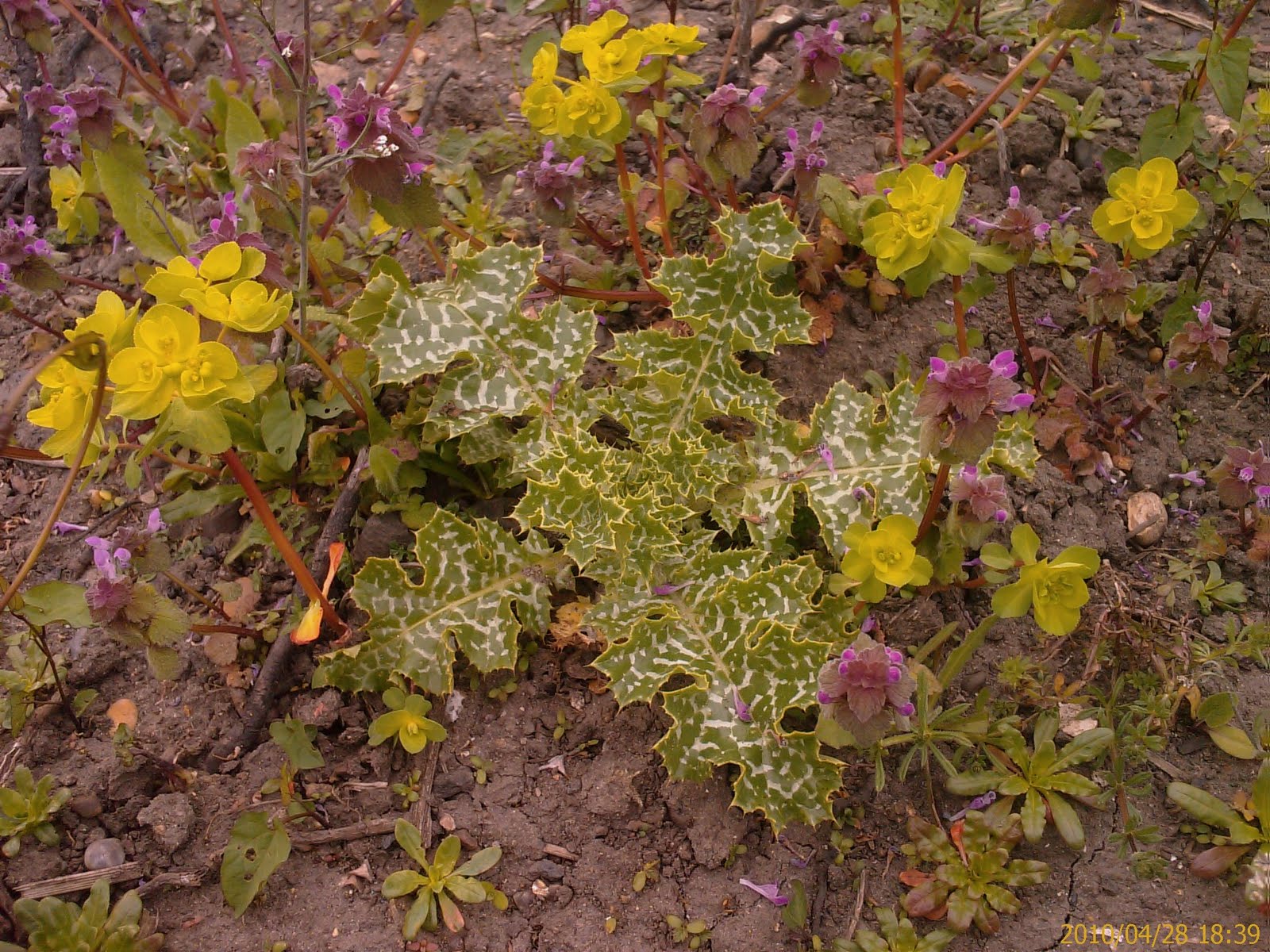
The best plant find was 16 specimens of Milk Thistle (Silybum marianum) amongst an unusually large number (circa 40) of Sun Spurge in a relatively bare patch of soil. This is an uncommon plant, possibly native, and in this instance probably a garden escape from seed. Besides the attractively white-veined leaves, it has a number of medicinal uses.

Milk Thistle amongst Sun Spurge

Monday, 26 April 2010

26/4/10 Gravel Hill, Hall Place and south of the Dartford Loop Line

A male Chaffinch was seen at the Erith Rd edge of Bursted Wood.

Some Brooms were in flower on the south-facing railway embankment just west of the Erith Rd bridge over the railway line.

A Red-tailed Bumblebee was the only insect around a strip of flowering Berberis darwinii at the junction of Highland Rd and Albion Rd, Bexleyheath.

A rather wayward pair of Mallard came down on a grass verge in Rossland Close, at the junction with Gravel Hill.

A Green Woodpecker was feeding along the shrub line at the top of the hill at Hall Place North (the parkland on the east side of Gravel Hill). At the bottom of the hill, near Bourne Rd, Thyme-leaved Speedwell - just coming into flower - was intermingled with Germander Speedwell. There was also some Slender Speedwell nearby.

In the newish shrub beds at the south east corner of the extended Hall Place car park parallel to Bourne Rd, there were 12 Common Fumitory growing up through the bark mulch, and not quite in flower yet. As far as I have been able to determine so far, this is a very infrequent plant, in the east of the Borough at any rate. No way were they going to overwhelm or inhibit the shrub planting, but it wasn't long before someone weeded them all out anyway...... A typicallly unintelligent, unimaginative and inflexible approach to vegetation management.

An attempt has been made to 'soften' the appalling car park recently built by the east side of the walled garden, and running right down to the river, with a couple of bits of ditch and an over-densely planted jumble of shrubs, full of natives, but some of them not indigenous to the local area. Is the assumption that half of them will die off?

Apart from the litter that had inevitably been blown - or thrown - into the ditches, and left there, there was a Grey Wagtail in one of them (and a Pied Wagtail on the roof of a building in the walled garden). Also several Celery-leaved Crowfoot just above the rather low water line. Here also, presumably brought in on the tyres of digging machinery, was a single plant of Shining Cranesbill (Geranium lucidum), my first record of it in Bexley, indeed in London south of the Thames.

Finds in the scrubby area (called The Old Orchard on one map I have) that is immediatly south of the railway opposite Hall Place, and on the east side of the A2, included the following (I haven't been here since I was a teenager in the 70s. My recollection - I have photos somewhere - is that is was then much more open, and people used to dig a Victorian (?) rubbish tip there for old bottles):

Rabbits
Dunnock
Long-tailed Tit
Pink-flowered, purplish-leaved Cherry (derived from garden cultivar)
Gorse
Broom
Marjoram
Hemlock
Ground Ivy
Hop

23- 26/4/10: Four days of firsts

Four days of first evers, firsts for the year and firsts for Bexley Borough - as far as my own recording effort goes anyway.

23/4 - My first ever Blackcap (yes, I'm not very good on birds - yet ....). Very good view of a male in a Willow by the Cray along By-way 105.

Lots of Marsh Marigold in flower along the By-way 105 and Footpath 106 sections of the Cray.

Marsh Marigold in flower by Footpath 106 on the River Cray

10 Tufted Duck at Five Arches Lake. Large Terrapin basking on a small island in the lake - presumably released by someone who found it too big to handle any more.

Speckled Wood, Peacock, 1 Comma and (first for year) one Brimstone on Foot's Cray Meadows. 4 Stock Doves (my first record of them in Bexley).

Several Chubb in the river. Grey Wagtail.

On the sewer embankment by Thames Rd Wetland was my first Odonatan of the year, a Large Red Damselfly. I also found two Grass Snakes not far from the River Cray (the first I've found myself and, embarassingly, only the second and third I've ever seen in the flesh).

Five Shelduck were in flight over 'flooded field north' on Dartford Marshes by Bob Dunn Way, and two more were at the confluence of the Cray and Darent where there were also a few small waders.

Two adult Foxes were brazenly running around by Howbury moat towards dusk.

24/4 - first sighting of a Grey Heron actually using the Thames Road Wetland (TRW) site.

Lots of Spotted Medick in flower along the Thames Rd bank of the TRW. My first ever conscious spotting/identification of the Annual Nettle (Urtica urens) which is presently abundant in the 'amenity shrub bed' mulch here.


Annual Nettle (Urtica urens), Thames Rd Wetland site. Note short flower clusters

Also 9 flowering plants of Common Star of Bethlehem (Ornithogalum umbellatum) here, my first ever record of the species, which is thought to be native to East Anglia and is occasional elsewhere, presumably as an escape. They no doubt arrived on this site in dumped soil/aggregate. Clearly one of those things that's unpalatable to rabbits .....

Common Star of Bethlehem (Ornithogalum umbellatum) by Thames Rd, Crayford

25/4 - London Natural History Society field trip - Erith Marshes (north of Belvedere) / Crossness.

Highlights were:

- Linnets
- Male Reed Bunting
- Whitethroat - (my first conscious sighting ever, or at least since I was a teenager)
- Lesser Whitethroat - my first ever - making its way up a stubby electricity pylon by a disused factory, doing a passable impression of a Treecreeper as it did so
- Some Swallows
- A Jay
- 2 Little Ringed Plover
- Great views of a male Garganey (my first ever) off the sewage works outfall (the best view several seasoned birders there had ever had of the species)
- About 15 Gadwall here also
- plus 2 Whimbrel - new to me
- plus 1 Black-tailed Godwit
- plus 1 Common Sandpiper (possibly another first for me, certainly in recent times)
- 2 Tern sp.
- 4 Wheatear (the group I was with at the time counted a total of 6), male and female, in a field south of the ghastly Incinerator

Thanks to the folks with the better equipment and ID skills who pointed several of these things out to me! No pics from me I'm afraid, still limited to my mobile phone camera ......

I should also mention the far from common Small Tortoiseshell butterfly seen. There were quite a few Peacock butterflies in what seems to be a good year for them.

There were swathes of Scurvy Grass in several places (probably English) along the Thames foreshore towards Erith (new species for me if either this or Common Scurvy Grass - latter said not to occur in SE England, at any rate it wasn't Danish scurvy Grass. I'll need another look to get a postive ID).


Scurvy Grass (probably English - certainly not the Danish) on Thames foreshore between Crossness and Erith. Plus a washed-up football.

Sedum album and Sedum acre found below the sea wall by a disused jetty towards the ADM site.

- Several Shelduck on the foreshore towards Erith
- 2 Oystercatchers on a 'stand-alone' platform (roughly opposite the Veolia premises on the Essex bank).

The day was rounded off superbly by this fabulous rainbow over the river (pictured here - but not done justice), which disappeared into the clouds, emerging to appear as if it was going to ground on the south side of the Thames. Even my wide-angle mobile phone cam lens couldn't have got it all in .....

26/4: Today's 'first' was my first record of Shining Crane's-bill (Geranium lucidum) in Bexley Borough or, indeed, anywhere in London south of the Thames. One plant skulking under a bit of fencing surrounding the ditch by the bl**dy awful new car park running down towards the river at Hall Place. Seed probably brought in during construction / 'landscaping' work.

Friday, 23 April 2010

23/4/10 - Abandoned cultivation by the Cray

Below by-way 105, between the River Cray 'embankment', and what's left of the River Wansunt, I found previously over-looked evidence of cultivation in the ground west of the Willow Carr, now rife with Giant Horsetail - the primaeval-looking spears of which are pictured emerging below .....


- a big clump of Division 2 Daffodils,


- a Paeony,


- a row of Currant bushes


and, finally, the skeletal remains of a rusted wheelbarrow.

Thursday, 22 April 2010

18 and 22/4/10: Barnehurst butterflies

In the garden:

18/4/10 - a Green-veined White

22/4/10 - a definite Peacock ID (probable sighting of this species a few days ago also), also a 7-spot Ladybird.

Saturday, 17 April 2010

17/4/10; Cowslips, birds and burning on the Cray and Darent

Bird numbers and species continue to dwindle on the drying flooded fields by Bob Dunn Way. Today on the 'south field' a Coot, a couple of Shelduck, 3 Mallard (one with ducklings), 2-3 Lapwings and 26 Starlings. In the 'north field' a Grey Heron landed and there were two pairs of Gadwall.

The GOOD find of the day was a patch of Cowslips with around 70 flowering stems between them:

Cowslips on Dartford Marshes


The BAD and the UGLY was this huge polluting fire on land to to south of the Cray, as I made my way back past Thames Rd Wetland at dusk.


Black smoke spreads across the Cray and well to the north of Crayford Way.

These pictures were sent to the Cray Riverkeeper Co-ordinator who was going to report the incident to relevant authorities. By contrast, two PCSOs on the river footpath who had come to see what was going on were disinclined to take any action.

On a more positive note, there were several Bats along the Cray riverside now it was dusk. One flew close around my head several times coming, maybe, within 2' of me. Appeared to be Pipistrelle sp.-sized.

There was a Fox playing with a plastic bottle on the grass at the bottom of Perry Street, not at all bothered by passing pedestrains or being strafed by the headlights of vehicles coming round the roundabout.

17/4/2010: First Speckled Wood of year, Wood Anemones open wide

More spring is sprung in Barnehurst ....


Bursted Wood on a sunny afternoon and the Wood Anemone flowers are open wide. As are the golden blooms of Lesser Celandine. Two Speckled Wood butterflies, my first of the year, chase each other as the sun streams through the still open canopy of a late spring.

Narcissus in Bursted Wood


Another swathe of Wood Anemone carpets the top of the cutting behind Barnehurst station's down platform along Hornbeam Lane. As usual the view was somewhat spoilt by the mass of litter chucked over the fence further along the Lane by morally and intellectually-challenged travellers and left to accumulate - for months at a time - by a railway company that never-the-less always seems to have the time and money to cut too much vegetation down too often and too short.