US social scientist Kenneth Boulding : ‘If you believe exponential growth can go on in a finite world, you are either a madman or an economist’.

Showing posts with label Milk Thistle. Show all posts

Sunday, 5 September 2010

5/9/10: Barnet botanising - checking out Colindale captures (un)Common Calamint

An LNHS meeting in Colindale, London Borough of Barnet, led by BMNH botanist Mark Spencer.

Mark is leading on the new Flora of London project (the last ran from 1966 to 1976), and the purpose of the visit was to get more records from a poorly-studied area that is within his own recording patch.

There was quite a big turnout, and by doing my usual thing of hanging off the back and side of the main group I found quite a few of the more interesting things that might otherwise have been missed including Stone Parsley (Sison amomum), Slender Trefoil (Trifolium micranthum) and Common Stork's-bill. Also Water Soldier (though this latter will have been put in the pond in Rushgrove Park deliberately). There was what I felt to be a disproportionate amount of interest the Swine Cress (Coronopus squamatus) I discovered hidden under some overhanging branches here - but apparently it's infrequent in north London.

Mark himself was excited by the Common Calamint (Clinopodium ascendens) I spotted in a front lawn on Colindeep Rd., because he says it's very uncommon in this part of London that was Middlesex, and various members started taking photos of it (luckily the residents didn't come out to ask what on earth was going on ....).

Later I went up to Edgware and Burnt Oak on my own and found a young Milk Thistle outside Burnt Oak Library in what appeared to be recently (re-)sown grass and a Wall Rue fern (Asplenium ruta-muraria) in the Watling Rd. railway bridge brickwork (pictures below).


There was a Little Egret in the Silk Stream near the Colindeep Road bridge, and a Long-winged Conehead cricket in Rushgrove Park.

Saturday, 5 June 2010

5/6/10: Notable bugs in West Tilbury, and some personal plant firsts

Today a London Natural History Society visit to an old sand quarry in West Tilbury, known for the rich assemblage of uncommon bugs that like the hot, dry conditions here with several south-facing slopes.

In particular, we were searching for species that are associated with Black Horehound and with Common Stork's-bill. This involved a lot of kneeling down and ferreting about under bits of plants pressed closely to the ground.

I wasn't familiar with these insects than, and can't claim to be after the event. Instead I recommend that readers check out the impressive macro photos on bug expert Tristan Bantock's flickr site. Those labelled Essex (Broom Hill) on these pages were found today:

http://www.flickr.com/photos/tristanba/page25/

http://www.flickr.com/photos/tristanba/page26/

but there are many other pictures in the overall collection that show the beauty and/or fascination of this small world around us that we barely notice, so I would urge readers to have a 'wander' round it.

London Natural History Society members scour the promontory at Broom Hill, Essex, for rare bugs, against a backdrop of the Thames Estuary

As it turned out, I did prove quite adept at finding target species, even though I didn't know what any of them were called. My notes record that, amongst other things, I caught an Arenocoris falleni under Stork's-bill (the first one of the day I think), a species for which Tristan notes this site is probably a first County record.

Other species I noted were:

- the relatively colourful Raglius alboacuminatus
- mating Megalonotus praetextatus
- Asiraca clavicornis, with weird antennae and wide front legs, which is now restricted mainly to the London area and Thames estuary. Pictures and more info here: http://www.britishbugs.org.uk/homoptera/Delphacidae/Asiraca_clavicornis.html://

Plants included a large number of Scotch Thistles and Slender Thistles, 2 Hare's-foot Clover, Common Bugloss, Fiddle Dock (uncommon in Essex) and Sheep's Sorrel. Plants new for me were the rare Subterranean Clover (Trifolium subterraneum), Bur Chervil (Anthriscus caucalis) a species found mainly in East Anglia and 4 specimens of Silver or Hoary Cinquefoil (Potentilla argentea).

Silver or Hoary Cinquefoil, Broom Hill, Essex

Our route back to the station turned out to be rather circuitous, as we trusted our directional instinct rather than a map, and wound up taking a rather longer route than necessary.

This Milk Thistle (Silybum marianum) was one of several in flower along the south side of the bottom of a hedge at the junction of Church Rd and Cooper Shaw Rd, West Tilbury.

Wednesday, 28 April 2010

28/4/2010: Mining (or should that be milking?) Erith Quarry for new records

An unsuccessful attempt to find some reptiles on the site today, but plenty of other interesting things were seen.

Peacock butterflies were very much in evidence, with several being observed.


A rather ragged Peacock butterfly basks on a piece of rubble

Other butterflies seen were a Speckled Wood, a pristine Comma and a Holly Blue.

Birds included Chiffchaff - two were heard at once at one point, and one was finally seen in the flesh, singing in a fairly open position, a Greenfinch, a male Chaffinch, a Green Woodpecker (good views), 9+ Swifts overhead (my first of the year) and a Whitethroat. All in all there was a tremendous amount of bird song here.

There were a number of apple (or possibly pear) trees in flower on the site.


One of several flowering fruit trees - presumably from an old core or bird-sown


A rather battered grove of Gorse in flower towards the north west corner of the site - someone drove a vehicle through part of it at some point

Cherry tree in flower

A dark-leaved, pink-flowered Cherry elsewhere on the site was presumably a seedling from a garden cultivar.

Other escapes from cultivation were Raspberry canes and a Swedish Whitebeam.

A stand of Fennel not previously noted was found, with one bronzey-leaved plant amongst the green ones.

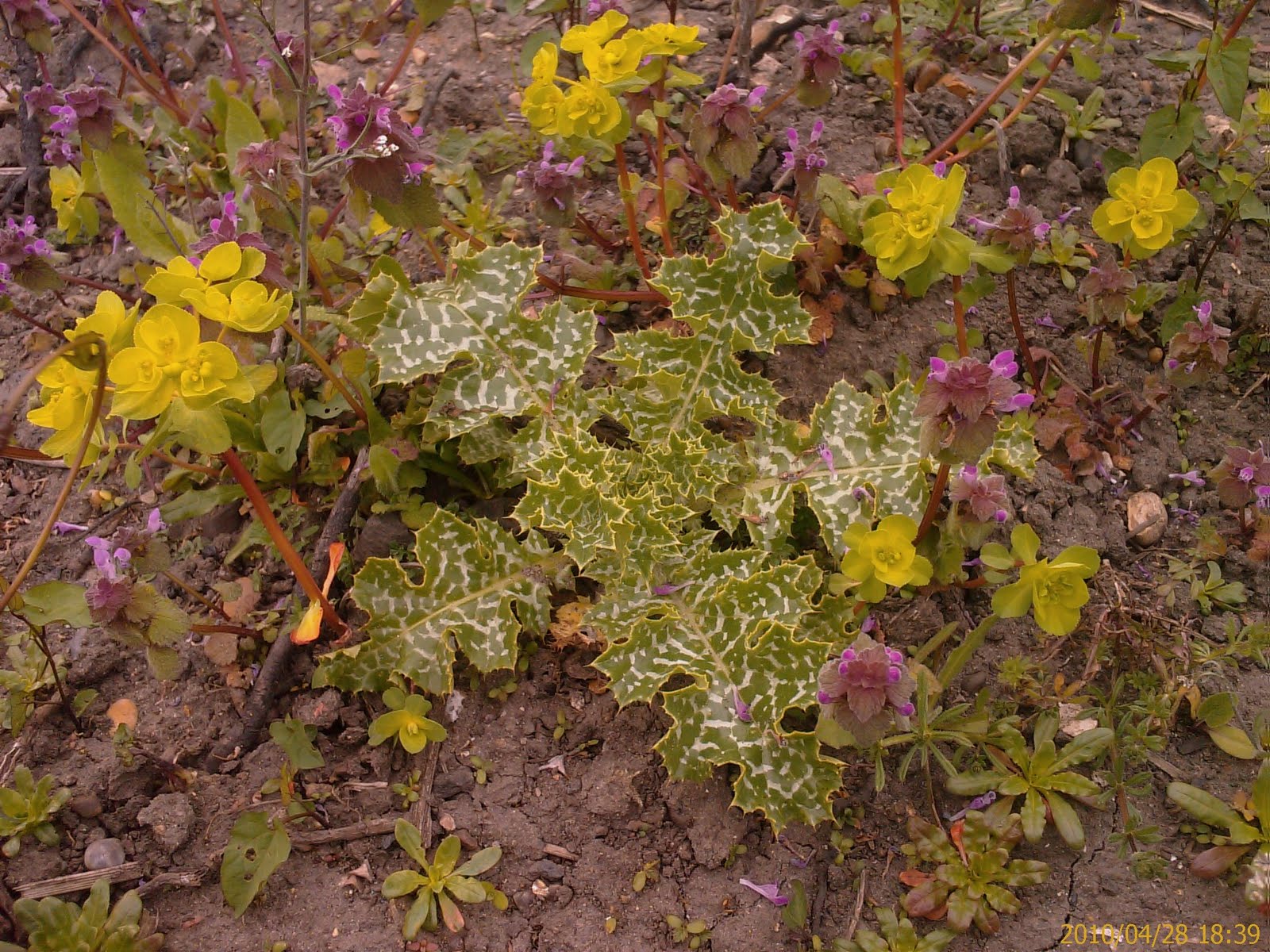
The best plant find was 16 specimens of Milk Thistle (Silybum marianum) amongst an unusually large number (circa 40) of Sun Spurge in a relatively bare patch of soil. This is an uncommon plant, possibly native, and in this instance probably a garden escape from seed. Besides the attractively white-veined leaves, it has a number of medicinal uses.

Milk Thistle amongst Sun Spurge